Kids’ Surfaces & Studs – Cheat Sheet
Quick 5‑step fit check
- Measure length: heel against a wall, stand on paper, mark longest toe; measure in cm.
- Compare brand chart (shoes vary).
- Allow growth room: roughly 7–12 mm (younger kids ~10–12 mm; older ~7–10 mm).
- Lockdown test: lace properly, jog & cut; heel shouldn’t lift, toes shouldn’t hit.
- Surface match: buy the outsole that matches their main pitch (FG / AG / TF / IN; SG only where permitted).
Fit & Sizing
How do I find the correct size and fit for junior football boots?
Finding the perfect fit is a three-dimensional challenge—it’s a balance between immediate performance and necessary growth room.
To get it right, ignore UK/US sizes and use the Junior Striker Drawing Test:
- The Drawing: Have your child stand on a piece of paper on a flat floor (with football socks on). Trace the foot outline, keeping the pen perfectly vertical.
- The Measurement: Measure the distance from the heel to the tip of the longest toe. This is your actual foot length in centimeters (CM).
- The Target CM Formula: Add a growth gap to the actual length:
Younger kids (U6–U10): Add 10–12mm (approx. a thumb’s width) to allow for growth spurts.
Competitive players: Add 7–10mm for a "locked-in" feel and better ball control.
- The Brand Match: Take your final "Target CM" and find that exact number in the CM or JP (Japan) column on the brand’s specific size chart.
Why it matters: Feet naturally expand during high-intensity sprints. Without this 7–12mm margin, children risk blisters, blackened toenails, and restricted circulation.
How do I know if a football boot is too narrow or wide for my child?
While length is easy to measure, width is where most fit issues occur. Since most size charts only show length, you must compare your child's foot shape to the boot's silhouette:
- The "Bulge" Test: If your child’s foot is significantly wider than the boot's soleplate, the material will bulge over the edges. This is a "Red Flag" indicating instability and potential for the boot to tear prematurely.
- Narrow Feet: "Speed" models like the Nike Mercurial are designed with a slim, aerodynamic silhouette for narrow feet.
- Wide/High-Volume Feet: Look for models with softer uppers (like the Adidas Copa) or those with adaptive lacing systems (like the Puma Future).
- Junior Striker Tip: If your child has a wide foot but insists on a speed boot like the Adidas F50, we recommend adding an extra 5mm to your calculated Target CM. This additional length provides the necessary midfoot volume for a wider foot to sit comfortably without being squeezed by the narrow 'speed' silhouette. This provides the necessary midfoot width while maintaining a secure fit.
Why do soccer shoes sizes vary so much between Nike, Adidas, and Puma?
You should never rely on UK or US sizes alone.
A "Size 4" in Nike often fits much tighter and narrower than a "Size 4" in Adidas.
This is because every brand uses a different "last" (the wooden or plastic mould used to shape the boot).
- Nike: Often runs narrower, especially in the Mercurial and Phantom lines.
- Adidas: Generally offers a more anatomical fit, but their "Speed" models can still be snug.
- The Solution: Always check the CM (Centimeter) or JP (Japan) size on the tongue of the boot. This is the only universal measurement that remains consistent across all brands. If you know your child needs a 23cm boot, you can find the right size in any brand’s chart.
Wide feet—what should I look for?
Choose models described as having a wider fit or those with softer leather uppers (like the Adidas Copa) that naturally stretch to the foot's shape over time.
Avoid very narrow, one-piece synthetic "speed" silhouettes if your child has a high-volume midfoot.
Junior Striker Tip: If your child insists on a narrow speed boot like the Adidas F50, we recommend adding an extra 5mm to your calculated Target CM.
This additional length provides the necessary midfoot volume for a wider foot to sit comfortably without being painfully squeezed, while still maintaining a secure, locked-in fit.
Can children wear orthotics or custom insoles in football boots?
Yes, but with a few technical requirements.
When choosing boots for orthotics, look for models with removable insoles (sock liners), which are common in "Pro" or "Elite" versions but often glued down in entry-level boots.
It is also crucial to select boots with a deeper heel cup.
Because orthotics raise the foot slightly, a shallow boot can lead to the heel slipping out during sprints.
Always bring the orthotics to the try-on and perform a quick "lockdown test" with sharp turns to ensure stability.
Surfaces & Studs
What are (FG) Firm Ground Football Boots?
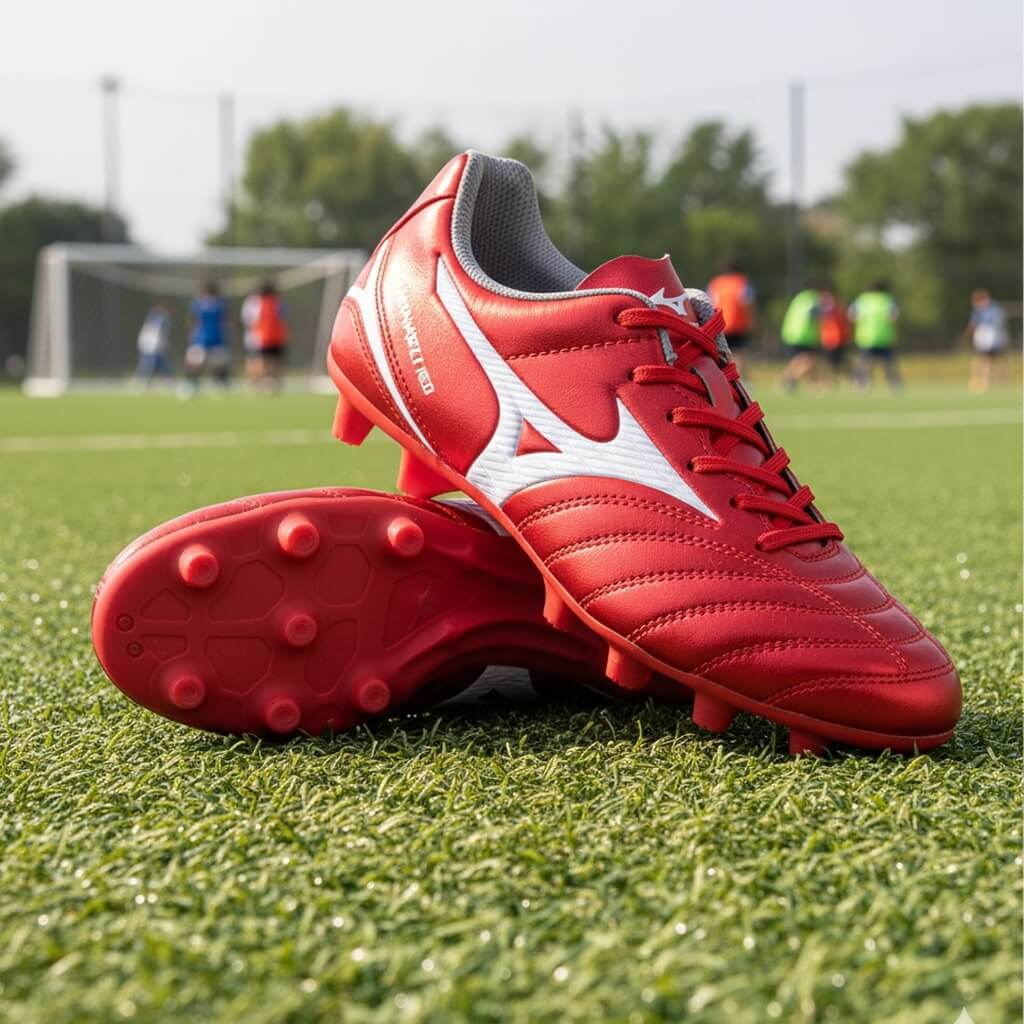
Firm Ground (FG) boots are the most popular choice for junior players, specifically designed for use on natural grass pitches that are dry or slightly damp.
- The Tech: They feature fixed (non-removable) studs made of hard plastic (TPU) or rubber. These studs are usually conical (round) for stability or bladed for maximum acceleration.
- ThePerformance: FGsoleplates are engineered to "bite" into the soil just enough to providetraction without getting stuck.
- Safety Note: While versatile, using FG boots on hard artificial turf can lead to "stud pressure" and discomfort.
For choosing firm ground junior boots checkout our expert picks for the Best Firm Ground Football Boots for Kids
Is it dangerous for junior players to wear FG boots on 3G or 4G artificial grass?
Although it is practical to have one pair of cleats, wearing the FG model on artificial grass is not recommended for young players.
FG studs are longer and designed to penetrate soil; on hard synthetic pitches, they do not dig in, which creates "stud pressure" on the soles of the feet.
More importantly, the high traction of FG blades on synthetic grass can cause the foot to "stick" during a quick pivot while the rest of the body continues to turn, significantly increasing the risk of ACL (knee) and ankle injuries.
For frequent training on artificial grass, AG (Artificial Grass) boots with shorter, hollow studs are a much safer choice for developing joints.
What are (SG) Soft Ground Football Bboots?
Soft Ground (SG) cleats are engineered exclusively for wet, muddy, and water logged natural grass.
In the Irish climate, these are often essential for winter matches to prevent dangerous slips.
- The Tech: Unlike FG boots, SG models feature longer, replaceable metal-tipped studs. Most junior SG boots use a "6-stud" configuration to penetrate deep into the mud.
- The Benefit: They provide maximum grip when a standard plastic stud would simply slide over the surface.
- Safety Warning: Never allow a child to wear SG boots on AstroTurf or hard ground.
Grip (or traction) is the friction that stops your foot from sliding when you push off, run, or change direction.
In this context, zero grip means that the metal studs fail to find any friction or purchase on the hard surface.
Instead of digging in to provide stability, they will simply slide across the top of the rigid ground.
It creates an extremely slippery and uncontrollable interface, similar to walking with metal spikes on a polished wooden floor or ice.
Consequence: The player will constantly slip, make it impossible to run or turn safely, and will likely fall over.
Jarring describes a sudden, forceful, and unexpected shock or impact to the body.
In this context, when a hard, sharp metal stud slams against a rigid, hard surface, there is no cushion.
All the energy of that impact is reflected back through the stud and directly into the player's foot.
This powerful, rigid shockwave travels straight up the leg and places extreme, unnatural stress on the joints.
Consequence: Unlike plastic studs on AstroTurf, which can flex or slide slightly, a metal impact is sudden and unabsorbed.
This repeated, harsh shock to the ankles, knees, and hips can cause immediate pain, joint inflammation, damage to cartilage, shin splints, and even stress fractures over time.
For choosing soft ground junior boots see our top-rated Junior Soft Ground Football Boots
When are Soft Ground (SG) metal studs necessary for kids?
Soft Ground (SG) boots, featuring longer metal-tipped studs, are designed exclusively for wet, muddy, and waterlogged natural grass.
In climates like Ireland , these become essential to prevent dangerous slipping.
However, many junior leagues ban metal studs entirely for safety reasons, so it is vital to check with your club before purchasing.
If permitted, always ensure the studs are tightened with a wrench before every game to prevent them from loosening mid-match.
What are (AG) Artificial Grass variants?
Artificial Grass (AG) boots are specifically designed for modern 3G, 4G, and 5G synthetic pitches.
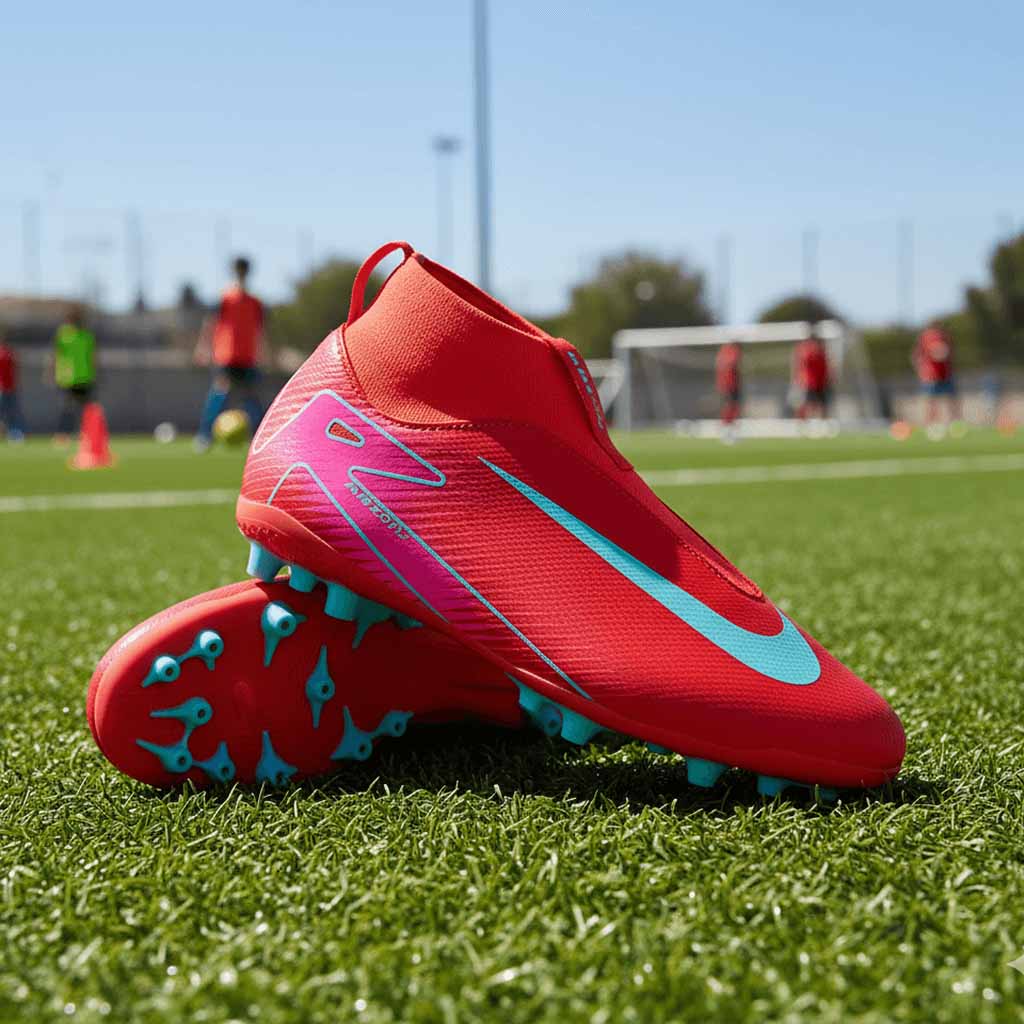
- The Tech: AG soleplates feature many short, circular, and often hollow studs. This design is crucial for spreading the player’s weight evenly across the harder synthetic surface.
- The Safety Factor: AG studs are designed to "release" from the turf during quick pivots. Using long FG studs on these pitches can cause the boot to get stuck while the body turns, which is a leading cause of ACL and ankle injuries in youth football.
- Durability: The friction of artificial turf generates significant heat; AG soleplates are made from heat-resistant materials to prevent the glue from melting.
For choosing artificial ground junior boots browse our guide to the Best AG Football Boots for Kids
What are (MG) Multi-Ground Footall Boots?
Multi-Ground (MG) boots are the "one-pair" solution for parents whose children switch between different surfaces every weekend.
- The Tech: MG soleplates are a hybrid. They feature a higher number of studs than an FG boot, but the studs are shorter and more rounded than a traditional blade.
- The Benefit: They offer a safe middle ground. They provide enough traction for dry natural grass but are short enough to avoid the dangerous "sticking" effect and stud pressure on artificial 4G pitches.
- The Verdict: If you are on a budget and can only invest in one pair of boots for both grass and turf, MG is the safest and most durable choice for a growing player.
Weather & Pitch Conditions
How do weather and pitch conditions affect the choice of junior soccer boots?
Weather isn't just a background detail; it’s a game-changer that dictates the physics of every turn and sprint.
Choosing the wrong configuration for the conditions is a mistake that even the world’s greatest have made.
The Ferguson Lesson: Discipline over Comfort
At the highest level of football, technical discipline is non-negotiable.
A famous story from Manchester United’s history involves Sir Alex Ferguson and striker Diego Forlán.
Before a match on a slick, wet pitch, Ferguson insisted Forlán wear high, interchangeable studs (Soft Ground) for traction.
Forlán, preferring the comfort of lower studs, ignored the instruction.
During the game, he slipped at a decisive moment and missed a massive scoring chance.
When Ferguson caught him changing his boots afterward, he famously ended Forlán's career at the club.
The Sideline Reality
This lesson applies just as much to youth football as it does to the Premier League.
We witnessed this firsthand during a national youth tournament in Serbia in 2023.
Heavy rain turned the pitch into a "skating rink." In a critical moment of the final, a player attempted a sharp turn, but his boots lost all traction.
The resulting slip led to a conceded goal, proving that even with talent and perspective, underestimating the surface is a mistake that leaves players unprepared for the conditions.
Technical Solutions for Harsh Conditions
To ensure your child is prepared for unpredictable weather, consider these technical factors:
- Anti-Clog Technology: On muddy pitches, standard boots gather dirt, becoming heavy and losing grip. High-end models (P1/P2) often feature a hydrophobic coating on the soleplate that prevents mud from sticking, keeping the boots light and the studs exposed.
- SG vs. FG in the Rain: On wet, natural grass, Soft Ground (SG) metal-tipped studs are often essential for safety. However, always check local regulations, as many junior leagues in Ireland and Serbia ban metal studs for safety reasons.
- The AG Heat Factor: On dry, hot days, artificial 3G/4G pitches can reach extreme temperatures. AG-specific boots are built with heat-resistant materials and adhesives to ensure the soleplate doesn't peel away from the upper due to friction and heat.
The Impact of Player Position
Does a child’s position on the pitch determine which football boots they should wear?
As a young player’s game evolves, their technical requirements change.
While a beginner only needs comfort, a competitive player needs tools that match their specific role on the team.
The Positional Transition: From the Goal Line to the Wing
We’ve seen this evolution firsthand in our own family.
My son started his journey as a Goalkeeper, where his priority was stability and a clean striking zone for goal kicks.
However, as his game developed, he transitioned into a Defender (Fullback) role.
This shift changed everything about his footwear needs.
Instead of just standing his ground, he now needs boots that handle constant overlaps, high-speed defensive tracking, and the durability to withstand tough tackles.
This personal journey is why we emphasize that "the best boot" depends entirely on where your child spends their time on the pitch.
Choosing by Position:
- The Goalkeeper: Needs a stable soleplate for lateral explosive movements and a textured upper for accurate distribution.
Explore more: Best boots specificaly designed for Goalkeepers
- The Defender: Focuses on protection, durability, and reliable traction for winning duels and tracking back.
Explore more: Best boots specificaly designed for Defenders
- The Midfielder: Prioritizes "touch" and "control." These boots often feature grip elements to help with precise passing and ball retention in crowded areas.
Explore more: Best boots specificaly designed for Midfielders and Best boots specificaly designed for Shooting and Passing
- The Speedster (Winger/Forward): For players who rely on pace, every gram matters. These are the lightest boots on the market, designed for explosive acceleration.
Explore more: Best boots specificaly designed for Speed
Care & Durability
How can I make my child's football shoes last longer?
The most important rule is to never use a washing machine, as the heat and spin cycle destroy the adhesives (glues) that hold the soleplate to the upper.
- The Cleaning Protocol: After every match, use a soft brush and lukewarm soapy water to remove mud. Always let them air dry naturally; placing them on a radiator will cause synthetic materials to crack and leather to stiffen and shrink.
- The "3G Pellet" Routine: If your child plays on artificial turf, black rubber pellets often get trapped under the insole. Remove the insole after every session to shake them out, as these pellets can act like sandpaper, wearing down the interior of the boot.
Step-by-Step Guide: Read our full tutorial on How to clean and maintain soccer boots to prevent premature wear.
Does leather require more maintenance than synthetic boots?
Yes. While leather boots (like the Adidas Copa) offer a superior, natural touch, they are "high-maintenance."
Leather is porous and can absorb water; if not dried properly and treated with a leather conditioner or "dubbin," it will become stiff and prone to cracking.
Synthetic boots are generally more "wipe-and-go" and tend to be more water-resistant, making them a popular choice for the wet Irish and Serbian winters.
Buying & Budget
Should I choose leather or synthetic boots for a junior player?
The choice depends on your child's foot shape and personal preference for "feel" on the ball.
- Leather: Ideal for children with wider feet because the natural material stretches and molds to the foot shape over time. It offers a dampened, padded touch on the ball.
- Synthetic: Perfect for players looking for a lightweight, barefoot feel. Modern synthetics are designed to retain their shape, meaning they won't stretch; what you feel on day one is how they will fit on day 100.
Deep Dive: Juniors’ leather soccer shoes
Is it worth buying "Elite" (P1) boots for a growing child?
This is a common dilemma.
While "Elite" models feature the thinnest materials and lightest tech, we often recommend the "Academy" or "League" (P2/P3) versions for junior strikers.
- The Growth Factor: Since children often outgrow boots every 6 to 9 months, spending over €250 on a single pair is rarely cost-effective.
- The Sweet Spot: Mid-tier models offer a fantastic balance of high-end aesthetics and durable materials that can withstand the rigors of youth football without breaking the bank.
Budget Friendly: See our top picks for the Best variants under 100 that don't sacrifice performance.
How many pairs of boots does a child actually need?
For most players, one high-quality pair of MG (Multi-Ground) or FG (Firm Ground) boots is sufficient for the season.
However, if your child is playing 3+ times a week on 4G pitches and has weekend matches on natural grass, a second pair of dedicated Astro (TF) or AG boots is a smart investment to prevent injury and reduce the wear and tear on their primary match boots.
Style & Performance Hacks
Are laceless shoes a good choice for junior players?
Laceless boots are incredibly popular because they offer a clean, uninterrupted striking surface and, let’s be honest, they look like the boots the pros wear.
However, there is a trade-off:
- The Pros: No more stopping the game to re-tie laces, and a sleek "barefoot" feel on the ball. They are also much easier for younger children to put on by themselves.
- The Cons: You lose the ability to customize the "lockdown." Since there are no laces to tighten, the boot must fit perfectly from the start. If the boot is even slightly too wide, the foot will slide inside, leading to instability.
- The Verdict: Great for players with "standard" foot shapes who value a clean strike. If your child has very narrow or very wide feet, a laced model is usually safer for ensuring a secure fit.
Top Picks: Check out our definitive guide to the Top 10 laceless models in Ireland to find the best-fitting models currently on the market.
How can I break in new football shoes quickly without causing blisters?
Taking a brand-new pair of boots straight into a 90-minute match is a recipe for blisters.
To ensure a perfect game-day fit, we recommend the Junior Striker Break-in Protocol:
- The Thick Sock Method: Have your child wear the new boots around the house for 20 minutes a day with two pairs of thick socks. This gently stretches the material without the friction of running.
- The Hairdryer Trick (Synthetics only): For tight spots on synthetic boots, use a hairdryer on medium heat for 60 seconds to soften the material, then have your child wear them while they cool down to mold the boot to their foot.
- Short Training Sessions: Use the new boots for the first 15 minutes of training, then switch back to the "old reliable" pair until the new ones feel supple.
Pro Secret: For more advanced techniques, including the "Warm Water Method" for leather, read our full guide on How to break in.


.jpg)
.jpg)